National Weather Service United States Department of Commerce

KLBB Radar
A Severe Thunderstorm Watch is in effect until 11 PM for the southern Rolling Plains and extreme southeast Texas Panhandle. Some storms will be capable of very large hail and damaging wind gusts.
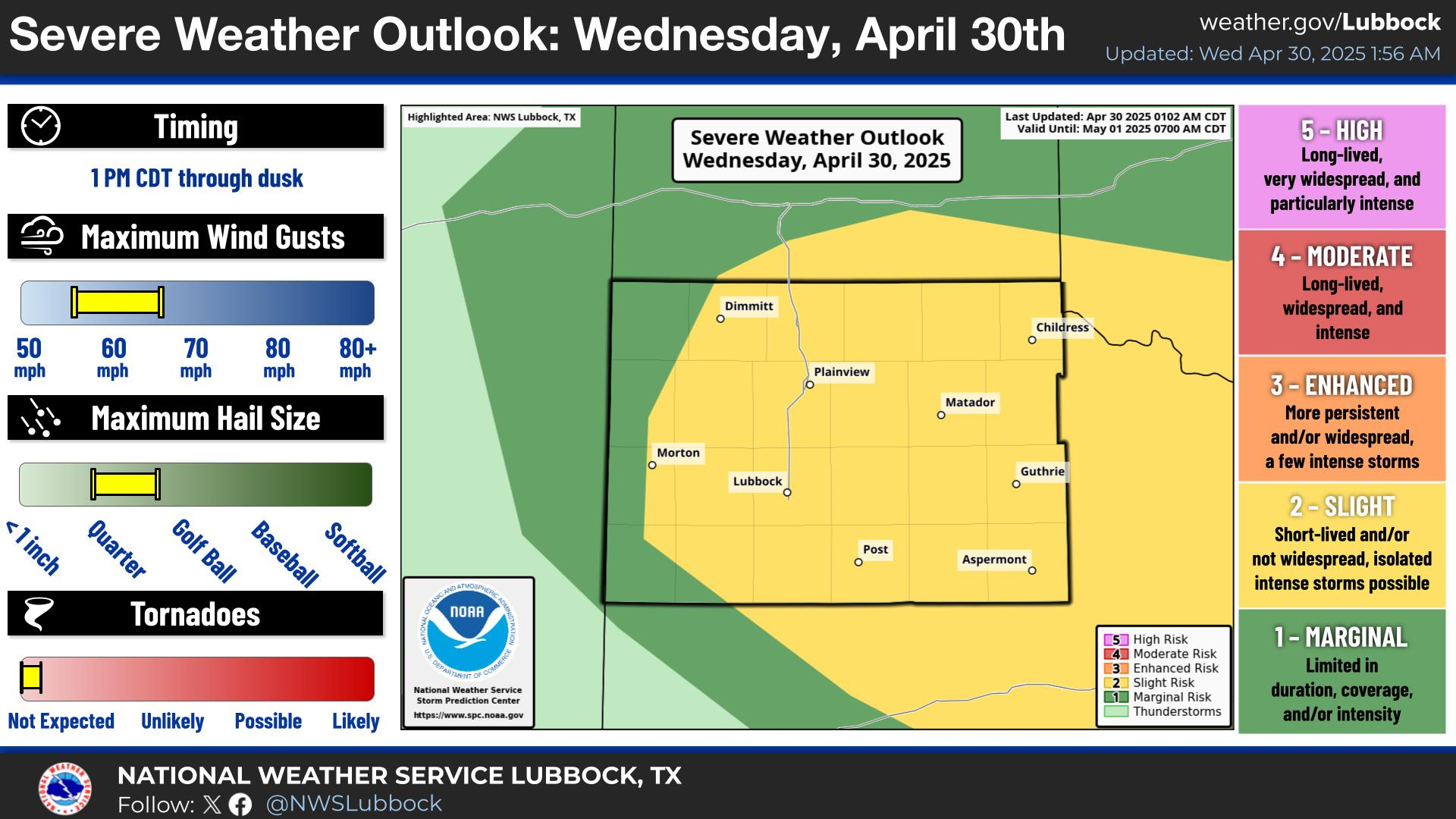
Thunderstorms, some severe, are forecast across the Rolling Plains this afternoon and evening, as the dryline centers itself near the US-82 corridor. Damaging winds up to 70 mph and large hail up to two inches in diameter will be possible with storms. If storms develop this evening (by 7 PM CDT and beyond), then storms may pose a risk for tornadoes in the Rolling Plains.
The combination of strong, southwesterly winds and low relative humidity will result in favorable conditions for the rapid growth and spread of wildfires across the far southern Texas Panhandle and portions of the Caprock. A Red Flag Warning is in effect between noon and 8 PM CDT today. A Fire Danger Statement is also in effect for counties adjacent to the Red Flag Warning. Avoid activities that involve the use of open sparks and/or flames, especially within the Red Flag Warning area.
A Wind Advisory is in effect between 1 PM and 7 PM CDT for the far southwestern Texas Panhandle and northern South Plains. Southwesterly winds between 25-35 mph, with gusts up to 45 mph, are expected this afternoon. Blowing dust will be possible.
Chances for showers and thunderstorms return to the region this afternoon and evening, tracking northeast across the Rolling Plains and far southeastern Texas Panhandle. All hazards will be possible including strong winds up to 70 mph, baseball sized hail, and a tornado or two cannot be ruled out.
Dry and breezy weather is expected for the rest of the week and into the weekend. Much cooler temperatures are forecast this weekend following the passage of a cold front moving in from the north.


Local Weather History For April 14th...
2011 (14th-15th): A potent upper air storm system slowly moved eastward over the Southern Plains on the 14th and 15th.
This system brought relentless winds to portions of West Texas and supported an outbreak of at least 36 wildfires across
the states of New Mexico, Texas and Oklahoma that burned more than 300,000 acres. This system began to influence weather
across the South Plains region of West Texas on the 14th, when westerly winds sustained in the 25 mph to 35 mph range
caused blowing dust and contributed to extremely critical fire weather. A localized and brief severe gust of 60 mph was
recorded at the Texas Tech University West Texas Mesonet site near Silverton shortly after 2 PM. Although new fire starts
on the West Texas South Plains were limited on the 14th, significant runs were observed on several ongoing massive and
long-lived wildfires including the Swenson and Cooper Mountain Ranch fires. As the upper air storm system slowly
progressed east, a strong cold front pushed southward across the region in its wake. Post frontal winds reached severe
levels, with gusts as high as 67 mph. The most intense winds occurred over the extreme southeastern Panhandle and the
northern Rolling Plains, in closest proximity to the exiting storm system. Although the winds were in the post frontal
environment, temperatures only cooled modestly behind the front, and relative humidities again dropped below critical fire
weather thresholds. The combination of damaging wind gusts and low relative humidities resulted in a swarm of new fire
starts over western Oklahoma and western north Texas, and another significant run of the ongoing Swenson and Cooper
Mountain Ranch fires on the South Plains which accounted for scorching tens of thousands of acres during the two-day
period.